Gentle Chiropractic Care in Penrith | Helping You Move Better and Feel More Confident
We help people with persistent back or neck pain move more freely, regain confidence, and get back to doing the things they love — gently, safely, and without forceful “cracking.”
About Your Penrith Chiropractor
At Your Spinal Health in Penrith, we specialise in gentle, low-force chiropractic care.
Our aim is simple: reduce pain, improve movement, and support your body’s natural healing.
Most people follow a short, structured plan over around 12 weeks and notice steady progress.
Everyone’s different, and results always vary — that’s why your care starts with a personalised Spinal Health Assessment.
Peter Bennett – Chiropractor
Registered with the General Chiropractic Council (Reg No: 01124)
Member of the United Chiropractic Association
Your Spinal Health
Registered chiropractic care in Penrith, Cumbria
5 Poets Walk, Penrith CA11 7HJ · 01768 899 036
Your Trusted Spinal Health Experts
At Your Spinal Health, we are passionate about helping you achieve your best health and well-being. We have been serving our community for over 20 years with a commitment to providing the highest quality care.
Combining natural hands-on treatment with our week-on-week progressive system to help symptoms like back pain, neck pain and headaches.
Start NOW. Just 1-click away
We help people feel safer and more confident moving again.
Save On Your Treatment Costs
Each visit is £50.
Save if you choose to pre pay.

Start NOW. Just 1-click away
Our clients tell us they can do more of what they enjoy once their pain is under control. Everyone’s different, and results vary.
Peter Bennett, Chiropractor – Registered with the General Chiropractic Council (Reg. No: 01124)
I'm Peter Bennett!
Hello, I’m Peter Bennett, a chiropractor based in Penrith, Cumbria.
I’ve spent more than 25 years helping people reduce pain, move better, and get more life back into their years.
My approach is gentle — no cracking, no heavy-handed adjustments — just safe, effective techniques that work with your body instead of against it.
Over the years, I’ve learned that the human body is incredibly good at trying to heal itself. My job is simply to understand what it’s trying to do and give it the right support.
People come to see me for all sorts of reasons — stiff backs after gardening, neck pain from long hours at a desk, or just feeling less steady than they used to.
Whatever brings you in, my goal is the same: to help you move more easily and feel more confident doing the things you love.
I believe great healthcare starts with kindness, clear explanations, and respect for each person’s pace. You’ll never be rushed or pressured here — just guided gently toward better movement and lasting results.
When I’m not in clinic, I’m usually outdoors walking in the fells, writing about longevity science, or creating online programs that help people stay active and independent later in life.

Why I Do This
When I first started in chiropractic, I thought the job was all about fixing spines.
But over the years, I’ve realised it’s really about helping people trust their bodies again.
I’ve seen how back pain can slowly chip away at someone’s confidence — the way they move, work, even how they laugh. One day it’s just a niggle, and before long it’s changed how they live. Helping someone turn that around, gently and safely, is still the best part of my week.
I’ve always believed the body isn’t broken — it’s doing its best to protect you. My role is to understand what it’s trying to do and guide it back toward balance. That might mean easing tension in the spine, retraining movement, or simply helping you breathe a little easier.
What keeps me going is seeing people realise they can do more than they thought — walking the fells again, picking up grandchildren, or just waking up without that constant stiffness.
It’s those moments that remind me why I chose this path all those years ago.
My aim has never been just to treat backs — it’s to help people move freely, live fully, and enjoy their years with confidence.
FAQS
What conditions can we help with?
Spinal health care can help a wide range of conditions, including back and neck pain, headaches, sciatica, joint pain, and even issues related to posture. It's not just about addressing the symptoms; it's about improving your overall health and well-being by improving the health of your spine and nervous system. If you have specific concerns or questions about your condition, please don't hesitate to ask for a consultation to discuss how spinal health care can benefit you.
Is spinal health care safe, and are the adjustments painful?
Spinal health care is generally considered safe when performed by trained professionals. The adjustments are typically not painful; in fact, many clients report feeling relief and improved mobility after an adjustment. Our therapists are highly skilled and will use gentle techniques tailored to your individual needs. Your comfort and safety are our top priorities, and we will explain every step of the process to ensure you feel at ease during your sessions.
How many visits will I need to see results?
The number of sessions you'll need depends on various factors, including the nature and severity of your condition, your overall health, and your treatment goals. Some clients experience relief after just a few sessions, while others may require more ongoing care. During your initial Spinal Health Assessment, we will assess your specific situation and provide a personalised treatment plan. Our goal is to provide efficient and effective care, so you can return to a pain-free and healthy lifestyle as soon as possible.
When should I see my doctor instead of a chiropractor?
Most back or neck problems are mechanical and respond well to gentle chiropractic care.
See your GP or call NHS 111 if you have fever, weight loss, cancer history, night sweats, recent trauma, numbness in the saddle area, bladder or bowel changes, severe unrelenting pain, or sudden weakness.
Call 999 immediately if you notice stroke signs —
Face drooping, Arm weakness, Speech changes, Time to call 999 (FAST) — or sudden dizziness, vision loss, or a severe new headache.
If you’re unsure, call us — we’ll help you decide the safest next step.
Latest Articles on Spinal Health
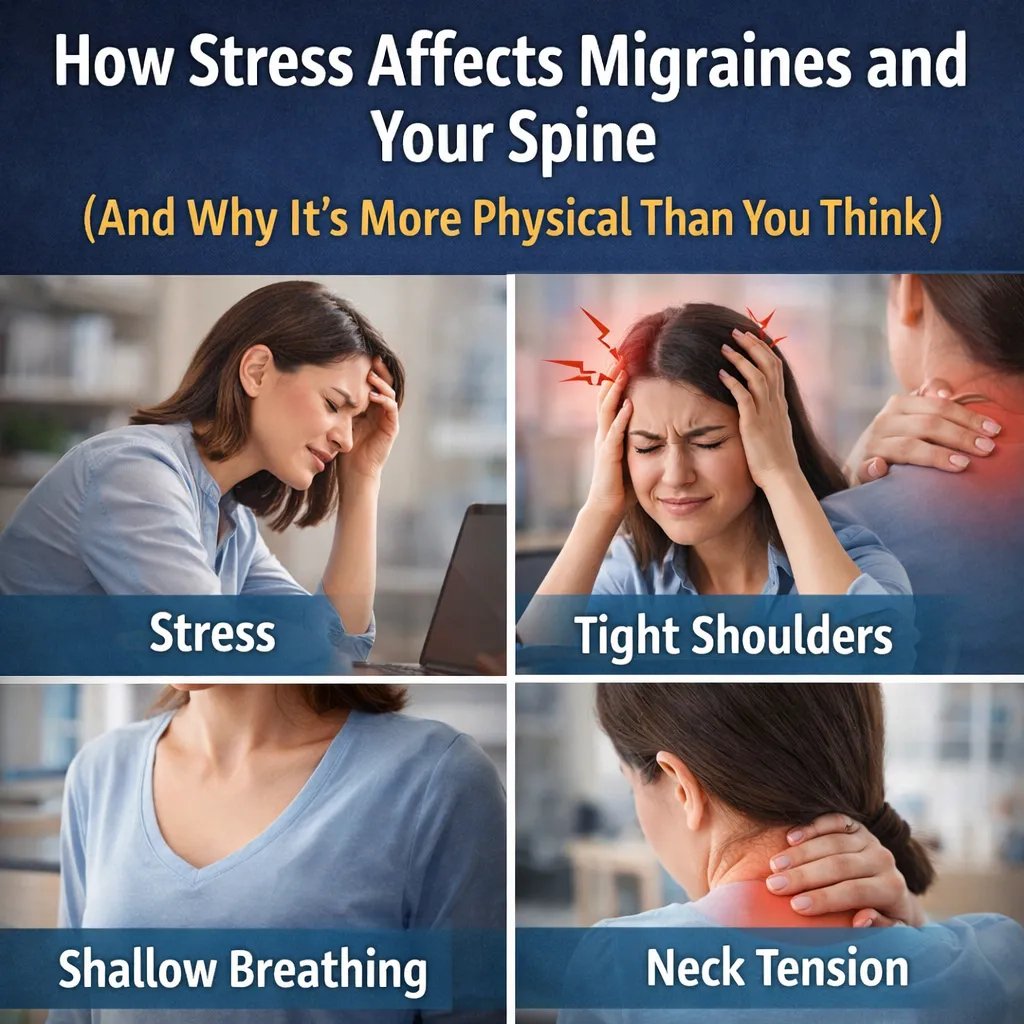
How Stress Causes Migraines (And What To Do About It)
Introduction
When people talk about stress and migraines, it often sounds vague.
“Try to relax.”
“Reduce stress.”
But that’s not particularly helpful.
Because stress is not just something you think.
It’s something your body does.
And when you understand what stress is doing physically, the connection to migraines becomes much clearer.
Stress Is a Physical State (Not Just Mental)
When you’re under stress, your body changes immediately.
Without you noticing, it:
tightens muscles
changes your breathing
increases alertness
reduces recovery processes
This is useful in short bursts.
It helps you respond quickly when needed.
But most people are not experiencing short bursts.
They are experiencing low-level stress all day, every day.
What That Does to Your Body Over Time
If stress continues:
muscles stay slightly tight
breathing stays shallow
your nervous system stays “on alert”
This creates a constant background load.
It doesn’t feel dramatic.
But it accumulates.
And your body has to carry it continuously.
Where Stress Shows Up Physically
Most people carry stress in predictable places:
neck
shoulders
upper back
jaw
You might notice:
tight shoulders at the end of the day
a heavy feeling in your neck
difficulty fully relaxing
These are not random.
They are your body adapting to ongoing pressure.
How This Links to Migraines
As this tension builds:
movement becomes more restricted
muscles work harder to stabilise
the nervous system becomes more sensitive
Over time:
→ your system becomes easier to trigger
→ your recovery becomes less effective
→ migraines become more likely
Again, not suddenly.
Gradually.
The Breathing Pattern Most People Don’t Notice
One of the biggest hidden factors is breathing.
Under stress, breathing becomes:
faster
shallower
higher in the chest
This reduces oxygen efficiency and increases tension in the neck and shoulders.
So even when you’re “resting,” your body is still working harder than it needs to.
Why You Can’t Just “Switch Off”
This is where people get frustrated.
They try to relax.
But their body doesn’t follow.
Because stress is not just a thought.
It’s a state your nervous system has adapted to.
And once that state becomes familiar, your body stays there automatically.
The Load vs Recovery Perspective
Stress is one of the biggest contributors to load.
If your total load is high:
your body holds more tension
your spine comes under more strain
your nervous system becomes more reactive
At the same time:
recovery reduces
sleep becomes less restorative
tension doesn’t fully release
This combination is what drives migraines.
Where the Spine Comes In
Your spine is central to how your body manages stress.
Because it:
protects your nervous system
coordinates movement
regulates muscle tone
When your spine is under strain:
your body finds it harder to relax
tension patterns become more fixed
your system stays in a more reactive state
This makes the effects of stress much stronger.
Why Stress Feels Worse Over Time
Many people notice:
“I used to cope better.”
“I don’t bounce back like I used to.”
That’s because:
→ the load has been building
→ recovery has been slipping
→ your system is closer to its limit
So the same level of stress now has a bigger impact.
What Actually Helps (In Practical Terms)
Telling someone to “reduce stress” is not useful.
But changing how your body handles stress is.
1. Reduce Physical Tension
regular movement
changing position throughout the day
avoiding long periods of stillness
2. Improve Breathing Without Overthinking It
slow down slightly
allow breathing to drop lower (into the abdomen)
avoid holding your breath during tasks
3. Create Small Recovery Points
Not big changes.
Small ones.
short breaks
stepping away from screens
brief moments where your body can settle
4. Support Your Spine
When spinal function improves:
tension reduces more easily
your nervous system becomes less reactive
your body can switch out of stress more effectively
What People Often Notice First
When this begins to change:
shoulders drop without effort
breathing feels easier
less constant tension
better sleep
These are signs your system is coming out of that stressed state.
Migraines often reduce after that.
Why This Works
Because it addresses the root pattern.
Not just the symptom.
You’re not trying to eliminate stress completely.
You’re improving your ability to cope with it.
When This Is Most Relevant
This is especially important if:
your migraines follow stressful periods
you feel physically tense most of the time
you struggle to relax even when you try
your symptoms have built up over time
Start Here
If you want to understand how stress is affecting your body physically:
👉 https://yourspinalhealth.com/
Related Articles
https://yourspinalhealth.com/post/why-migraines-build-over-time
https://yourspinalhealth.com/post/neck-tension-and-headaches
The Next Step
The next step is to assess how your spine is coping with the load your body is under.
I will assess your spine and discover if treatment could help:
👉 https://yourspinalhealth.neptune.practicehub.io/p/book-online?atid=448