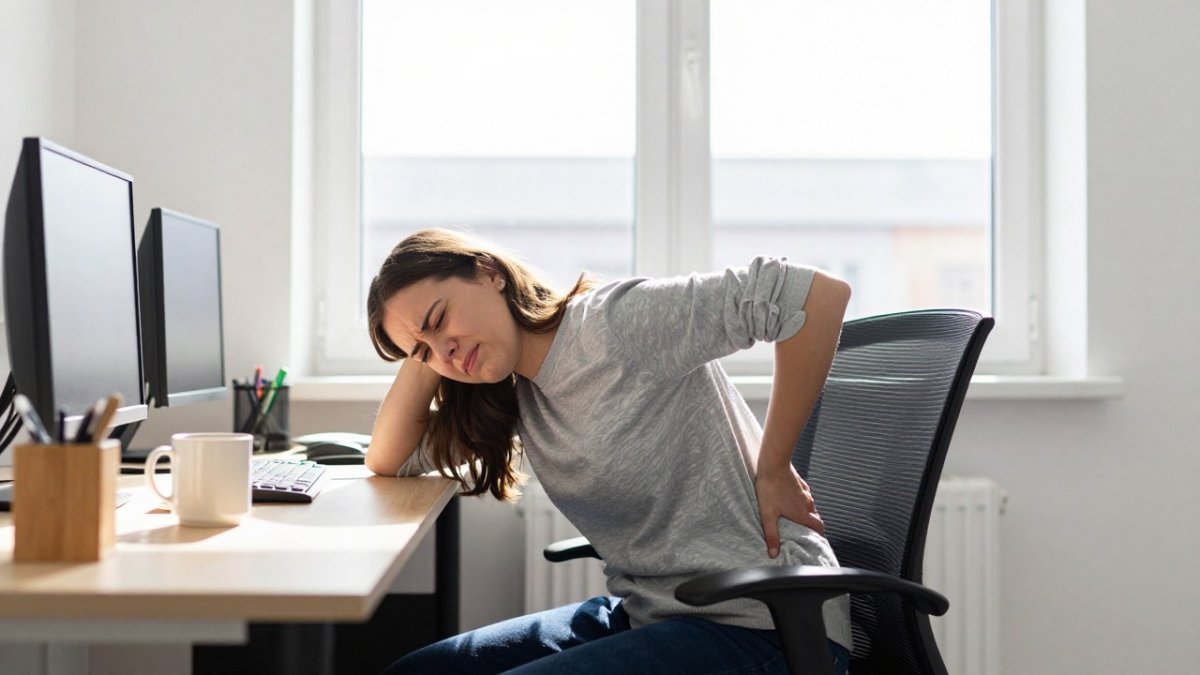
Why Sitting All Day Causes Hip Pain for Office Workers
Last Updated: November 19, 2026
Quick Summary
Why sitting all day causes hip pain is mainly down to holding the hip bent for hours, which keeps the hip flexors short while the glutes switch off. Over time this imbalance makes everyday movement, such as standing up or climbing stairs, feel stiff and sore.
- Long periods of sitting keep the hip bent, so the hip flexors stay shortened for hours.
- Glute muscles at the back of the hip can become less active, adding strain to the joint.
- Stand up and move for two to three minutes every 30 to 45 minutes.
- Set your chair so your feet rest flat and your knees sit level with or below your hips.
- Get prompt medical advice if pain is sharp, worsens at night, or comes with numbness or weakness.
Table of Contents
- Why Sitting All Day Puts Strain on Your Hips
- Tight Hip Flexors and Shortened Muscles After Long Hours at a Desk
- Muscle Weakness, Stiff Joints and Poor Desk Posture
- Why Hip Pain Hits When You Stand Up After Sitting
- Hip Pain or Back, Nerve and Referred Pain? How to Tell the Difference
- How to Relieve Hip Pain From Sitting: A Progressive Plan
- Booking Your Spinal Health Assessment in Penrith
- Frequently Asked Questions
Why Sitting All Day Puts Strain on Your Hips
Hip pain is one of the most common complaints among people who spend their working day in a chair. If you sit at a desk for six or eight hours, your hips are doing a lot of quiet work, which is why sitting all day causes hip pain for so many people, and they rarely get a break. If you are unsure whether pain travelling down your leg is coming from your hip, back or nerves, you can book a sciatica assessment to find out.
Sitting for long periods keeps the hip in a bent position for hours, and this is a key reason why sitting all day causes hip pain in otherwise healthy adults. The hip flexors, the muscles at the front of the hip, stay shortened, while the muscles around the back and side of the hip switch off. Over time, that imbalance can make everyday movement feel harder. Your body is not broken, but it is being asked to hold one position far too long.
The problem is often less about one bad moment than the same posture repeated every day. That is why hip pain from sitting can build slowly, then show up as an ache when you climb stairs or get out of the car.
Tight Hip Flexors and Shortened Muscles After Long Hours at a Desk
When you sit, your hip flexors stay in a shortened position. To understand how this connects to back weakness, you can read how prolonged sitting affects your hip muscles. A common mistake is to think that a muscle that feels tight must simply be overworked. In practice, a muscle that stays short for hours can lose some of its ability to move freely, and it can start to pull on the pelvis and lower back.
Tightness and weakness often come as a pair. The muscles at the front of the hip become short, while the glutes at the back become less active. Your body then leans on the wrong muscles to do the job, which adds strain to the hip joint.
What this means day to day:
- Standing up can feel stiff for the first few steps
- The front of the hip may feel tight or pinch when you stretch
- Walking may feel less smooth until you have moved about for a while
Muscle Weakness, Stiff Joints and Poor Desk Posture
Poor posture makes these problems worse, but it helps to be precise about how. Slumping forward or perching on the edge of the chair shifts weight unevenly through the hips and pelvis. When the pelvis tilts backwards, the hip joint sits in more flexion than it needs to, and the deep muscles that stabilise the hip, the glutes and the muscles around the side of the hip, become less active.
Desk setup matters, and small adjustments are usually enough. A useful starting point for most desk workers:
- Set the chair height so your feet rest flat on the floor and your knees sit level with or slightly below your hips. If your chair is too low, your knees rise above your hips and the pelvis tilts backwards.
- Adjust the backrest so it supports the curve of your lower back, and sit back into the chair rather than perching on the front edge.
- Raise your screen so the top of the display is roughly at eye level (Working safely with display screen equipment). If the screen sits far below eye level, you lean forward for hours, which loads the front of the hip.
- Keep your keyboard and mouse close enough that your elbows stay near your sides, so you are not reaching forward and rounding your upper back.
- If your feet do not reach the floor, use a footrest rather than letting your legs hang.
What ergonomic fixes can and cannot do is worth being honest about. A better chair, a footrest or a standing desk can reduce how much your hips have to work against, and they make it easier to change position. If you want practical guidance written for people who sit all day, read our chiropractor guide for office workers. They do not, on their own, undo hours of stillness.
The same principles apply away from a standard office. If you work from home at a kitchen table, the table height often forces your shoulders up or your arms forward, raise the laptop on books and use a separate keyboard if you can.
Watch out: if your pain is sharp, worsens at night, or comes with numbness, weakness or swelling, do not wait for it to settle on its own. Speak to a qualified healthcare professional promptly (the NHS).
Why Hip Pain Hits When You Stand Up After Sitting
Many people notice that hip pain is at its worst in the first few seconds after getting up from a chair. This is because the hip joint and surrounding muscles have been held in one position. When you stand, they must suddenly take your full weight and move through a new range.
This stiffness usually eases as you move around, which is one reason why regular movement breaks help. Standing up slowly, shifting your weight from side to side and taking a short walk can make the transition far more comfortable.
Hip Pain or Back, Nerve and Referred Pain? How to Tell the Difference
Hip pain from sitting is not always coming from the hip itself. Pain can travel from the lower back, or be felt in the buttock or down the leg because of nerve irritation. Telling these apart matters, because the right approach depends on where the problem starts.
Here is a simple way to think about it:
- Hip joint pain is often felt in the groin, front of the hip or outer thigh, and may worsen with weight bearing or certain movements
- Back-related pain tends to be felt in the lower back and may ease or change with position
- Nerve or referred pain can travel down the buttock or leg, sometimes with tingling or numbness
A clear assessment is one of the best ways to sort this out.
How to Relieve Hip Pain From Sitting: A Progressive Plan
Relief usually comes from small, regular steps rather than one big fix. What follows is a general structured plan you can follow at home, with progressions and adaptations for different starting levels.
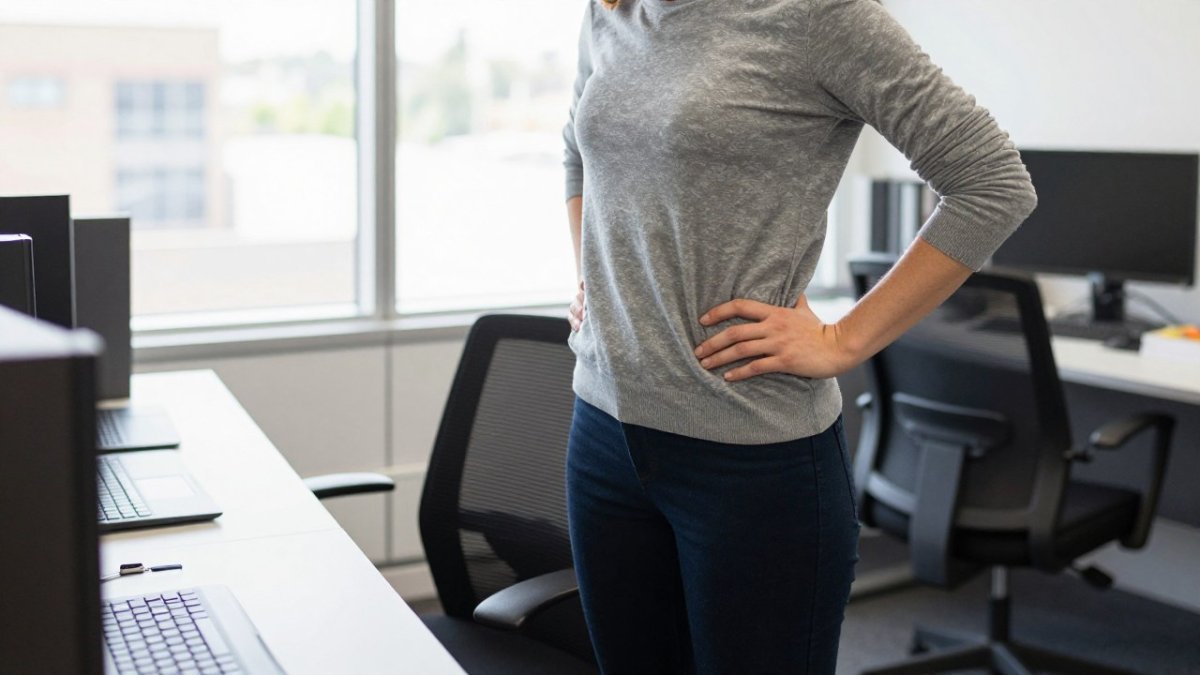
The daily foundation: movement breaks
Before any exercise, change how you sit. Stand up and move for two to three minutes every 30 to 45 minutes. Set a timer if you need to. On a busy day, a walk to the kettle and back counts; the point is to break up the stillness, not to exercise hard.
Week one: reduce the load and restore gentle movement
- Adjust your chair so your feet rest flat and your knees sit level with or slightly below your hips.
- Try a gentle hip-flexor stretch in a supported half-kneeling position, holding for 20 to 30 seconds on each side. Keep the movement comfortable rather than pushing into a pinch.
- Add a simple mobility drill: sitting tall, slowly tilt your pelvis forwards and backwards 8 to 10 times, then make small circles with your knees.
If you are very stiff or new to exercise, do the stretch once on each side and the mobility drill once a day. If you are already active, you can repeat the stretch two or three times on each side.
Week two: add gentle strength
- Glute bridges, lying on your back, for 8 to 10 repetitions. Squeeze the buttocks as you lift, and lower slowly.
- Standing side leg raises, holding a chair for balance, for 8 to 10 repetitions on each side.
- Keep the movements slow and controlled. Quality matters more than quantity.
Adaptation: if glute bridges are uncomfortable, start with smaller lifts or simply practise squeezing the buttocks while lying down. If side leg raises feel unstable, reduce the range and hold the chair with both hands.
Week three onwards: build tolerance
- Walk for 10 minutes at lunchtime, building towards 15 to 20 minutes over a few weeks.
- Add short mobility work for the hips and lower back, for example, a seated figure-of-four stretch and gentle trunk rotations.
- Progress the strength work by adding a second set, or by slowing the movements down rather than adding weight.
- Track how your hips feel after work, and adjust the plan if pain flares. A mild ache that settles within a day is usually a sign to hold steady; sharp or lasting pain is a sign to ease back and seek advice.
Adapting the plan to your situation
If you drive for a living or commute long distances, do the hip-flexor stretch and mobility drill after your journey rather than before. If you work from home, attach the movement breaks to something you already do, after each meeting, or when you refill your water.
A useful general principle is to move little and often. Start with what feels comfortable, and if a movement sharply increases your pain, stop and speak to a practitioner.
Booking Your Spinal Health Assessment in Penrith
If your hip pain keeps returning, or you are not sure whether it is coming from your hip, back or nerves, a proper assessment can help you find out. You can see what to expect at a Spinal Health Assessment before you book. If pain travels from your back or buttock down your leg, a proper assessment can help you understand what is going on.
Hip pain from sitting is common, but it does not have to become a permanent part of your working day. Small changes to how you move and sit can make a real difference over time.
Frequently Asked Questions
Why do my hips hurt after sitting all day?
Long periods of sitting keep the hip flexors in a shortened position, so the muscles at the front of the hip can become tight and stiff. Hip joints also get less movement and less blood flow when you sit still for hours. Over time, weak gluteal and core muscles may struggle to share the load, which can leave the hip feeling sore when you finally stand. Pain that is persistent, worsening or accompanied by night pain, swelling, fever or numbness should be assessed by a qualified professional rather than assumed to be from sitting.
Can sitting for too long cause hip pain?
Yes, prolonged sitting is a common reason people notice hip discomfort. Staying in one position for long periods can reduce hip-joint mobility, tighten the hip flexors and leave the surrounding muscles under-used. Regular position changes and short movement breaks often ease the build-up of stiffness. Because hip pain can also come from the back, nerves or other conditions, it is sensible to have symptoms checked if they do not settle with changes to your routine.
What stretches can help hip pain from sitting?
A gentle hip-flexor stretch, performed by kneeling with one knee down and gently shifting the hips forward while keeping the back upright, can help ease tightness at the front of the hip. Seated figure-four stretches and gentle walking can also help restore movement. Stretches should feel comfortable rather than sharp, and should be stopped if they increase pain. A qualified professional can advise which movements suit your particular situation.
How can I prevent hip pain when I work at a desk?
Setting your chair height so your feet rest flat and your hips sit slightly above your knees can reduce strain. Changing position regularly, standing up for a minute or two every half hour and walking during breaks all help keep the hips moving. Building short, regular strengthening work for the hips and core can also support posture over time. Ergonomic changes can help, but they work best alongside movement, as no single desk setup removes the need to move.

