Yoga Poses for Neck and Shoulder Pain: A Gentle Routine
Last Updated: 24 November 2026
Quick Summary
Gentle yoga poses can ease neck and shoulder pain when done slowly and without force. Cat-Cow, Thread the Needle, Child's Pose and Cow Face Pose are good starting points because they move the upper spine and shoulder blades without loading the neck.
- Hold each pose for about 5 breaths, or 1 to 2 minutes for Child's Pose.
- The full 10-minute sequence suits once or twice a day for desk workers and standing shifts.
- Add a second short session in week two, and Warrior II only in week four.
- Stop any pose that causes sharp pain, dizziness or tingling.
- See a GP or physiotherapist if pain persists after two to three weeks or spreads into an arm.
Table of Contents
- Which Yoga Poses Help With Neck and Shoulder Pain?
- Before You Start: Setting Up Safely at Home
- Step-by-Step Poses for Neck Tension
- Step-by-Step Poses for Shoulder and Upper-Back Tension
- A Gentle Yoga Routine for Neck and Shoulders at a Desk or Standing Job
- Modifications, Warning Signs and When to See a Professional
- Book Your Spinal Health Assessment in Penrith to Find Out What Is Driving Your Pain
- Frequently Asked Questions
Which Yoga Poses Help With Neck and Shoulder Pain?
Gentle yoga poses can ease neck and shoulder tension when done slowly and without force.
Many people with neck and shoulder pain find yoga helps most as a daily habit: the movements are small, repeatable and easy to stop if something feels wrong.
Yoga is not a cure for every type of neck or shoulder pain. Consistent movement patterns integrated into your routine help to reduce shoulder tension while preventing the recurrence of these common physical stresses.
- Cat-Cow: mobilises the mid and upper back
- Thread the Needle: opens the upper back and shoulder blades
- Child's Pose: lets the neck and shoulders rest
Before You Start: Setting Up Safely at Home
Choose a flat, non-slip surface and a mat or folded blanket. Wear comfortable clothing and keep your phone within reach in case you need to pause.
Set a timer for about 10 minutes. Move slowly, breathe out as you move into each pose and in as you return. Stop any movement that causes sharp pain, dizziness or tingling.
Watch out: do not push into a stretch to "make it work". More force usually leaves the neck more irritated the next day.
Step-by-Step Poses for Neck Tension
Neck tension often builds from holding the head forward for long periods. If your neck pain is linked to desk work, step-by-step guidance on fixing desk neck pain covers more than gentle stretches. These poses gently reverse that position and encourage the neck muscles to relax.
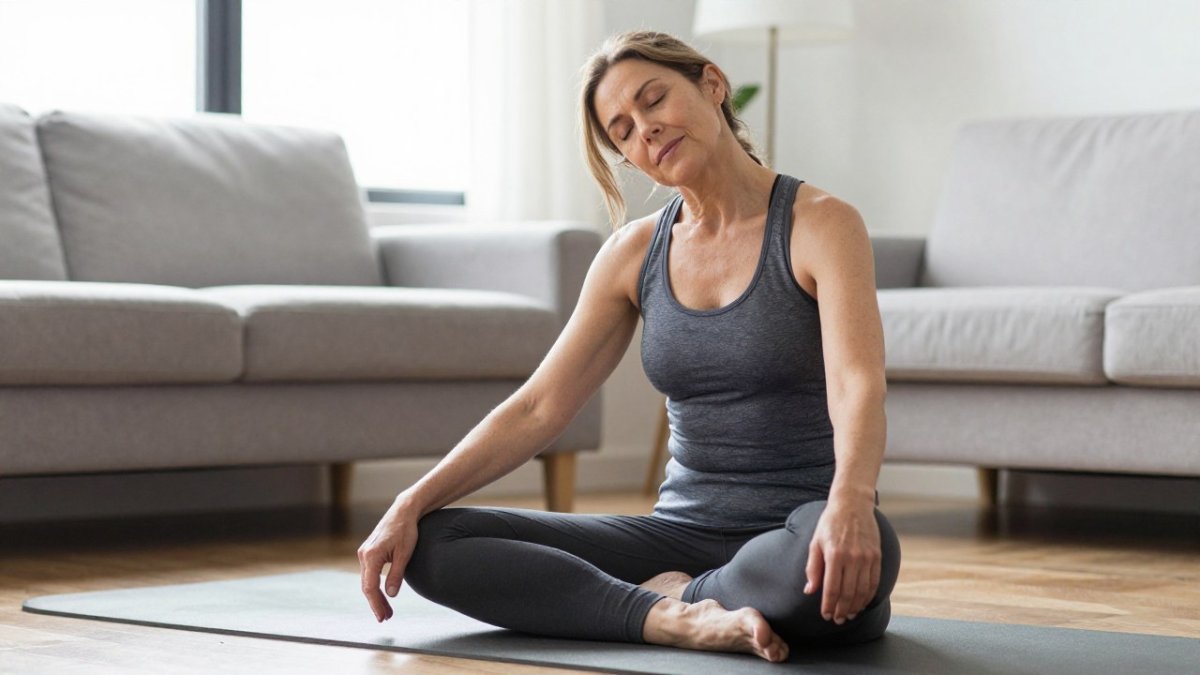
Cat-Cow Pose and Thread the Needle Pose
Cat-Cow Pose
- Start on your hands and knees, with wrists under shoulders and knees under hips.
- Breathe in and let your belly drop while you lift your chest and gaze gently forward.
- Breathe out, round your back, tuck your chin and let your head soften.
- Repeat slowly for 5 to 8 breaths.
Thread the Needle Pose
- From hands and knees, slide your right arm under your left arm so your right shoulder and temple rest on the mat.
- Keep your hips stacked over your knees and let your neck stay relaxed.
- Hold for 5 breaths, then slowly come back and switch sides.
Expected result: a gentle stretch across the upper back and back of the neck, without sharp pain.
Child's Pose and Cow Face Pose
Child's Pose
- Kneel with your big toes touching and sit back towards your heels.
- Rest your forehead on the mat or a folded blanket and let your arms rest by your sides.
- Breathe slowly for 1 to 2 minutes.
Cow Face Pose
- Sit tall with your legs crossed, or on a cushion if your hips feel tight.
- Reach your right arm up and bend the elbow so your hand moves down your back. Reach your left arm behind you and try to clasp hands.
- Hold for 5 breaths, then switch sides. If you cannot clasp, use a strap or simply keep both hands on the thighs.
Many people find this pose tight on one side. That is normal. Do the same number of breaths on each side and do not force the clasp.
Step-by-Step Poses for Shoulder and Upper-Back Tension
Shoulder tension often comes from reaching, carrying and sitting with rounded shoulders. These poses open the chest and shoulder blades, which can ease the load on the neck.
Seated Shoulder Rolls
- Sit tall and roll your shoulders back and down, 5 times in each direction.
- Keep the movement small and slow.
Eagle Arms (Gentle)
- Sit or stand tall and cross your right arm under your left, bringing the palms together if comfortable.
- Lift the elbows gently and breathe for 5 breaths. Switch sides.
Standing Forward Fold with Support
- Stand with feet hip-width apart and bend forward, letting your hands rest on a chair or table.
- Keep your neck long and breathe for 5 breaths.
Warrior II is a helpful standing pose once the shoulders feel more comfortable. Keep your front knee bent, your arms level with the shoulders, and your gaze over the front hand. Hold for 5 breaths on each side.
A Gentle Yoga Routine for Neck and Shoulders at a Desk or Standing Job
This 10-minute sequence suits people who sit or stand for long periods.
The 10-minute sequence
- Seated shoulder rolls (1 minute). Sit tall, feet flat, and roll the shoulders back and down five times, then forward and down five times. Breathe out as the shoulders roll back; keep the movement small.
- Seated Cat-Cow (2 minutes). Hands on knees. Breathe in as you lift the chest and gently look up; breathe out as you round the upper back and tuck the chin. Move for 8 to 10 slow breaths. At a desk, do this on the chair rather than the floor.
- Thread the Needle (2 minutes, both sides). From hands and knees, slide one arm under the other and rest the shoulder and temple on the mat. Hold for 5 breaths, then switch. If the floor is not practical, sit tall, place one hand on the opposite knee and gently turn the upper back, holding for 5 breaths each side.
- Cow Face Pose (2 minutes, both sides). Sit tall on a cushion if the hips feel tight. Reach one arm up and bend the elbow so the hand moves down the back; reach the other arm behind and clasp if you can, or hold a strap. Hold for 5 breaths, then switch, doing the same number of breaths on each side.
- Child's Pose (2 minutes). Kneel with big toes touching, sit back towards the heels and rest the forehead on the mat or a folded blanket. Breathe slowly for 1 to 2 minutes. If the knees complain, place a cushion behind the knees or do a seated forward fold instead.
- Standing forward fold with support (1 minute). Stand with feet hip-width apart, bend forward and rest your hands on a chair or table. Keep the neck long and breathe for 5 breaths. Come up slowly to avoid dizziness.
Breathing cue for the whole routine: breathe in through the nose and out through the nose or mouth, making the out-breath slightly longer than the in-breath.
Progression over four weeks
- Week 1: do the sequence once a day, using the timings above. Stop any pose early if it feels sharp.
- Week 2: add a second short session of shoulder rolls and seated Cat-Cow in the middle of the day.
- Week 3: increase Thread the Needle and Cow Face to 8 breaths per side if the first week felt comfortable.
Adapting to a desk job versus a standing job
- Desk job: the main trigger is prolonged sitting with the head forward. Do the seated shoulder rolls and seated Cat-Cow every hour, and save the floor poses for lunchtime or after work. Set a timer rather than relying on memory.
- Standing job: the main trigger is holding the arms and shoulders in one position. Do shoulder rolls and Eagle Arms every hour, and use Child's Pose and the supported forward fold at the end of the shift to unload the upper back.
Use this table to plan how often to practise:
| Routine | Frequency | Best for |
|---|---|---|
| Full 10-minute sequence | Once or twice a day | Desk workers and standing shifts |
| Shoulder rolls and seated Cat-Cow only | Every hour | Long sitting or standing shifts |
| Child's Pose before bed | Nightly | Winding down stiffness |
Notice whether a pose helps or aggravates your symptoms. Relief during or after the pose is a good sign.
Watch out: do not add the Week 4 progression until the first three weeks have been comfortable; adding Warrior II too early is a common reason people flare up.
Modifications, Warning Signs and When to See a Professional
Every pose can be adapted, and the right modification is usually the difference between a routine that helps and one that irritates the neck.
| Pose | Chair or seated option | Range-of-motion adjustment | Caution |
|---|---|---|---|
| Cat-Cow | Seated Cat-Cow with hands on knees | Move only through a comfortable range; do not force the look-up | Stop if the neck feels pinched at the top of the movement |
| Thread the Needle | Seated upper-back twist with one hand on the opposite knee | Rest the head on a cushion rather than the mat | Avoid if the shoulder cannot bear weight; use the seated twist instead |
| Child's Pose | Seated forward fold with forearms on a table | Place a cushion behind the knees or under the forehead | Avoid if kneeling is painful; use the seated fold |
| Cow Face Pose | Seated with a strap between the hands | Keep the lower hand on the hip if the clasp is not available | Do not force the clasp; stop if the shoulder pinches |
| Eagle Arms | Seated with the arms crossed lightly over the chest | Cross only to the point of a gentle stretch | Avoid if there is shoulder instability or recent injury |
| Standing forward fold | Seated fold with hands on thighs | Bend the knees generously | Come up slowly if you are prone to dizziness |
Modifications for specific situations
- Recent injury or surgery: get clearance from your GP or physiotherapist before starting, and begin with chair-based options only.
- Osteoporosis or known spinal conditions: avoid loaded forward folds and deep twists; keep the spine long and the movements small.
- Dizziness or low blood pressure: avoid quick changes of position and standing forward folds; sit or use a chair for the whole routine.
Warning signs and what they may mean
These signs do not diagnose anything on their own, but they are reasons to stop the routine and seek advice rather than push on.
- Pain that travels down the arm or into the fingers: this can suggest nerve involvement in the neck or shoulder and should be assessed rather than stretched.
- Numbness, tingling or weakness in the arms or hands: these are nerve-related symptoms and are not something to work through with yoga.
- Headaches that start during or after the routine: this may mean the neck is being loaded in a way it does not tolerate; stop the pose that brings it on.
When to see a GP or physiotherapist
Book an appointment if the pain has not settled after two to three weeks of gentle practice, if it keeps returning, or if any warning sign above appears. In the UK, contact your GP surgery or self-refer to an NHS physiotherapy service in many areas; a pharmacist can advise on short-term pain relief (the NHS). If you have private cover or prefer to pay, a chartered physiotherapist can assess the neck and shoulder directly.
These signs can have many causes, and only a qualified professional can work out what is happening.
Book Your Spinal Health Assessment in Penrith to Find Out What Is Driving Your Pain
If your neck or shoulder pain keeps coming back, a Spinal Health Assessment can help you understand why.
Neck pain or stiffness that never quite goes away is worth checking early. You can also read what to expect at a Spinal Health Assessment in Penrith before you decide.
Book Your Spinal Health Assessment to get a clear picture of what is causing your pain and whether this routine is right for you.
Frequently Asked Questions
Is yoga good for neck and shoulder pain?
Gentle yoga can ease muscle tension in the neck, shoulders and upper back for many people, mainly by encouraging slow movement, breath awareness and relaxation of tight muscles. It is not a guaranteed cure, and results vary depending on what is driving the pain. Start with small ranges of movement, stop any pose that sharpens symptoms, and arrange a consultation with a qualified professional if the pain is persistent, worsening or accompanied by other symptoms.
Which yoga poses should I avoid if my neck hurts?
Avoid deep backbends, full neck rolls, headstands, shoulder stands and any pose that forces the head into end-range rotation or extension while the neck is painful. Deep forward folds that strain the neck can also aggravate symptoms. Choose seated or supported poses with the head kept in a neutral position, and ease out of any movement that produces sharp pain, tingling or numbness. If in doubt, speak to a healthcare professional before continuing.
What yoga for neck pain can I do at my desk?
Seated Cat-Cow movements, slow shoulder rolls, gentle chin nods and a seated twist can be done at a desk between tasks, held for a few slow breaths each. Keep the movements small and comfortable, and avoid pushing into any position that causes discomfort. Pairing these with regular breaks from sitting and adjusting your screen height can support the same goal of reducing everyday neck and shoulder tension.
When should I seek professional advice for neck or shoulder pain?
See a qualified healthcare professional if your neck or shoulder pain lasts longer than a few weeks, wakes you at night, follows an injury, or comes with numbness, tingling, weakness in the arms or hands, dizziness, or changes in bladder or bowel control. Book a consultation with a qualified practitioner at Your Spinal Health in Penrith if you want a personalised assessment of what is driving your symptoms before continuing with a self-directed routine.

