Understand Your Spine
Your scan came back normal. Your back didn't get the memo.
Seven lessons that explain what the tests never did, from a chiropractor of 30 years.
If you have been told nothing is wrong, and your body keeps disagreeing, this is for you.
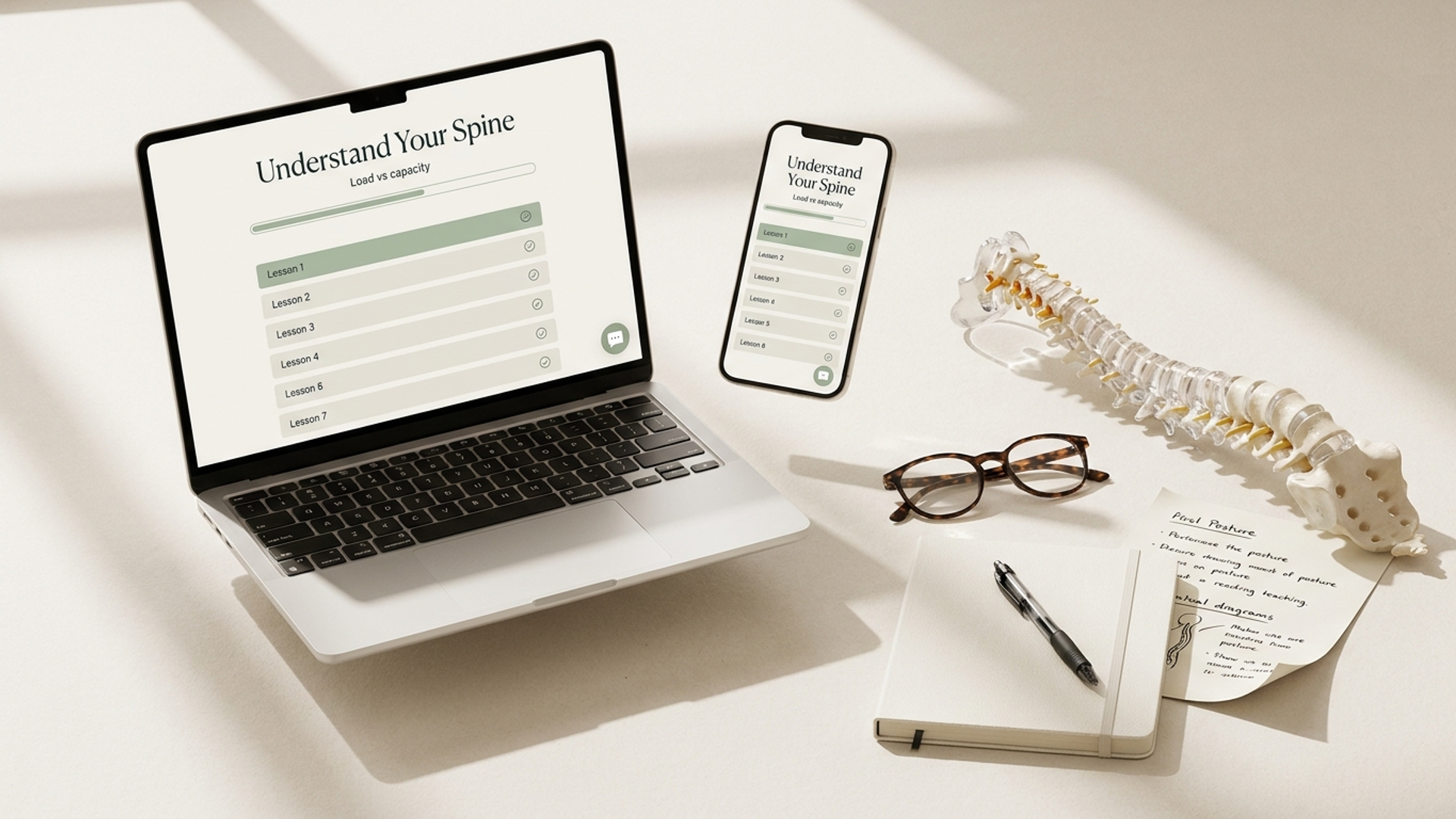
The gap between your scan and your back has a name
Load versus capacity. Your tests are normal because tests measure structure. They show what your spine looks like. They don't show what it has been carrying, or how much carrying it can currently tolerate.
The trouble lives in the gap, and no scan measures the gap. I have spent 30 years in clinic watching this exact scene: people told their tests were fine, whose bodies kept saying otherwise.
Watch the first lesson
Seven lessons, and the work that goes with them
Not a list of exercises to memorise. Not a diagnosis. The model I have used for three decades, taught so you could explain it to a friend in two sentences.
Six questions that tell you whether this course is safe for you, or whether you should see a doctor today. It comes first for a reason.
The beginning of the load audit. What your spine has actually been carrying, including the load most people never count.
Load and capacity worked out on paper, until you can see which dial is yours to turn.
The four kinds of load, and the two almost nobody accounts for. This lesson is usually the one that lands.
What the imaging really shows, what it doesn't, and why a disc on a scan is not a sentence.
A baseline number, the one rule that decides whether a movement is right for you, and a fortnight of your own evidence. Plus a bad-day protocol for the flare.
The honest split between what's fixed and what's yours to build. No reassurance, no doom.
The rule that keeps you safe from yourself
Most back advice fails in the same way. It gives you something to do, and then nothing tells you when to stop.
A movement is inside your tolerance if you could do it again tomorrow, at the same amount, without bracing, and without paying for it that evening.
If you have to hold your breath, tighten everything, or spend the evening recovering, it was too big. Halve it. Restart at the amount that was easy, not at zero. And when a weekday gets heavy, the dose goes down, not up.
There is no list of safe exercises, and no progression you have to keep up with. There is a dose, and a way of reading your own body that makes the dose obvious. That is what you leave with.
The part most courses don't have: you can ask it back
This is a course with a tutor that has read every lesson and knows the model. At 11pm, when your back has flared and last Tuesday's lesson has gone blank, you don't have to wait for a Monday appointment. You ask. It answers in plain words, pulls up the lesson you need, and explains the bit you didn't follow.
It knows where you are in the course, and it will slow you down. Ask it for a programme, ask how fast this works, tell it you pushed through the pain, and it sends you back to the rule above and to your own worksheet. Doing more is the risk here. It is what put most people on this page to begin with.
Two things it will never do: tell you what is wrong with your back, or diagnose you. If you need a personal read on your own spine, that is a conversation with a human being, and it will say so.
Why a chiropractor is telling you this

I could sell you a block of appointments. This page would be longer and I would make more money. I have been in practice long enough to know that what changes someone's relationship with their back is not the technique, it is finally understanding the mechanism.
So this is the explanation I give across a desk, made portable, with the same care about how much you take on and how fast. It doesn't compete with hands-on care. It sits under it.
I don't promise you an outcome, and you should be sceptical of anyone who does. Loading history matters: too much load and too little both cause harm, and a spine's tolerance for load is changeable. That is what the evidence supports, and that is what I teach.
Who this is for
You have had the tests. You have had the advice that didn't stick. You have started to half-wonder whether it is just your age, or in your head. It isn't. It is usually load you were never taught to see.
You don't need to be in agony to get value here. A stiff back that comes and goes, a niggle after sitting, or simply wanting to understand your own body before something goes wrong, all belong here.
It is not for you if you are in acute severe pain, have neurological symptoms, or are waiting on a diagnosis. Read the red flags first. Get seen.
Questions people ask before they start
What exactly do I get?
Seven written lessons that teach the load-versus-capacity model, a worksheet at the end of most of them, and a tutor trained on all of it. You can read the course in an afternoon; the worksheets then run over the following fortnight. It is yours to revisit any time.
Is this a treatment or a diagnosis?
No, and I want to be precise. This is education about the principles of spinal health. It is not a diagnosis and not treatment of any specific condition. It works alongside hands-on care and never replaces it.
Are you prescribing exercises?
No. I teach the principle of dosing, and a rule you apply yourself: could you do this again tomorrow, same amount, without bracing, without paying for it that evening. What you choose to move is yours to judge.
Is it safe if my back is bad right now?
The first lesson is a six-question screening, and if anything on it rings true the answer is see a doctor today, not read another lesson. The course is written for the common, non-dangerous majority whose scans came back normal.
Will the AI tell me what's wrong with my back?
No. It teaches the principles and answers questions about them. It won't diagnose you, interpret a scan, or tell you what to do about a specific symptom. That boundary is deliberate, and it is in the first lesson.
Are you trying to replace my chiropractor or physio?
The opposite. Most people I treated over 30 years spent the first appointment confused about what was happening to them. If you understand the mechanism, the care you get goes further and you can tell good advice from a sales pitch.
Is there a subscription?
No. £97 once, and it is yours. No renewal, no monthly charge.
What if it doesn't help?
Work through the course and the worksheets. If it doesn't clear anything up for you, tell me and I'll refund you. No forms, no fuss.
Seven lessons
£97, one time. No subscription, no renewal, yours permanently.
Get the course for £97Dr Peter Bennett BSc DC, 30 years in clinic. Roughly the cost of two clinic appointments.