Non-forceful Chiropractic Treatment for Seniors
Table of Contents
- What Non-forceful Chiropractic Treatment Means
- Gentle Chiropractic Techniques for Seniors
- Why Seniors Benefit from Non-forceful Approaches
- Safety of Chiropractic Adjustments for Osteoporosis Patients
- How to Find a Registered Chiropractor for Seniors
- What to Expect During Your First Session
- Common Concerns About Non-forceful Treatment
- Frequently Asked Questions
Last Updated: September 30, 2026
What Non-forceful Chiropractic Treatment Means
Non-forceful chiropractic treatment for seniors is a gentle approach to spinal care that avoids high-velocity, low-amplitude adjustments. Instead of the sudden "cracking" movements many people associate with chiropractic care, non-forceful methods use slower, controlled techniques that respect the body's natural limits.
This approach matters because ageing bodies change. Bones become more fragile. Joints lose flexibility. Muscles tighten. A method that works well for a 30-year-old may cause harm to someone in their 70s. Non-forceful chiropractic treatment for seniors recognises these differences and adapts accordingly.
At Your Spinal Health, we focus on understanding what your spine actually needs rather than applying a one-size-fits-all technique. The goal is relief, movement, and lasting improvement.
Gentle Chiropractic Techniques for Seniors
Several proven techniques fall under the non-forceful category. Each one has different benefits depending on your specific needs.
Low-force adjustments and mobilisation
Low-force adjustments use minimal pressure and slow, deliberate movements. Rather than a quick thrust, the chiropractor applies gentle pressure over several seconds, allowing your joints to move gradually into better alignment.
Mobilisation is slightly different. Instead of the chiropractor moving your joint, you move it yourself while they guide and support the movement. This gives you control over how far the movement goes. If something feels uncomfortable, you can stop immediately.
Both techniques work well for seniors because they:
- Reduce sudden stress on fragile joints
- Give your nervous system time to adapt
- Allow you to feel what's happening throughout the movement
- Minimise inflammation and soreness afterwards
Many older adults find mobilisation particularly reassuring because they're actively participating rather than having something done to them.
Soft tissue therapy and trigger point release
Soft tissue work focuses on muscles, not joints. A chiropractor uses their hands, fingers, or specialised tools to apply sustained pressure to tight muscle areas. This reduces tension, improves blood flow, and helps muscles relax.
Trigger point release targets specific knots in muscle tissue that refer pain to other areas. A tender point in your shoulder blade might actually be causing your neck pain. By releasing the trigger point, the referred pain often disappears.
This technique is particularly helpful for seniors because:
- It addresses muscular stiffness without moving joints
- It improves circulation to areas that feel stiff
- It's deeply relaxing for many people
- Results often feel immediate
Postural assessment and movement guidance
How you sit, stand, and move throughout the day shapes your spine's health. A postural assessment identifies patterns that create or maintain pain.
Your chiropractor observes how you move, checks your spinal alignment, and identifies which muscles are overworking to compensate for weakness elsewhere. They then teach you specific movements and positions that support better alignment.
This might include:
- How to sit at a desk without straining your neck
- Exercises that strengthen weak areas
- Stretches that lengthen tight muscles
- Everyday habits that reduce stress on your spine
For seniors, this guidance is often the most valuable part of treatment because it gives you tools to manage your own spinal health between sessions.
Why Seniors Benefit from Non-forceful Approaches
Your spine changes significantly as you age. Discs lose water content and become less flexible. Joints develop arthritis. Bones lose density. Muscles weaken. These changes are normal, but they mean your spine needs different care than it did decades ago.
Non-forceful chiropractic treatment for seniors acknowledges these changes rather than ignoring them. A technique that's safe and effective for a younger person might cause injury or excessive soreness in someone older.
Beyond safety, gentle approaches often produce better results for seniors. When your body isn't stressed by forceful movements, it can focus on healing. Inflammation decreases. Movement improves more gradually but more lastingly. You feel better without the soreness that sometimes follows aggressive treatment.
Many older adults also report feeling more confident about their care. When you understand what's happening and feel in control of the process, you're more likely to stick with treatment and follow guidance between sessions.
Safety of Chiropractic Adjustments for Osteoporosis Patients
Osteoporosis weakens bones, making them more prone to fracture. If you have osteoporosis, certain chiropractic techniques are genuinely unsafe and should be avoided entirely.
Book Your Spinal Health Assessment →
High-velocity adjustments, twisting movements, and forceful mobilisation carry real risk for people with bone density loss. Even moderate force can cause fractures in severely weakened areas.
However, non-forceful chiropractic treatment for seniors with osteoporosis can be safe when your chiropractor:
- Takes a detailed medical history and asks specifically about bone density
- Uses only low-force techniques with your full informed consent
- Avoids twisting or rotational movements
- Focuses on soft tissue work and gentle mobilisation
- Monitors your response carefully
- Works alongside your GP or specialist if appropriate
The key is transparency. Your chiropractor must know about your osteoporosis diagnosis and must discuss which techniques are suitable for you. If someone dismisses your concerns or insists that their approach is safe for everyone, find someone else.
How to Find a Registered Chiropractor for Seniors
Not all chiropractors specialise in gentle, non-forceful care. Finding someone with the right experience and approach matters.
Start by checking registration. In the UK, chiropractors must be registered with the General Chiropractic Council (GCC) (GCC). You can verify a chiropractor's registration on the GCC website. Registration isn't optional, it's a legal requirement. If someone calls themselves a chiropractor but isn't GCC-registered, they're operating illegally.
Beyond registration, look for these signs of genuine experience with seniors:
- Their website or materials specifically mention work with older adults
- They describe non-forceful or gentle techniques
- They ask detailed questions during initial contact about your medical history
- They're willing to explain their approach in plain language
- They mention assessing movement patterns before treating
- They offer a free initial consultation to discuss your needs
When you contact a clinic, ask directly: "Do you specialise in gentle, non-forceful treatment?" Listen to how they answer. A good response explains their philosophy and techniques. A vague response ("We treat everyone") suggests they may not have specialised experience.
Your Spinal Health takes this approach seriously. Our assessment focuses on understanding your specific needs before recommending any technique, and we offer gentle, personalised chiropractic care.
What to Expect During Your First Session
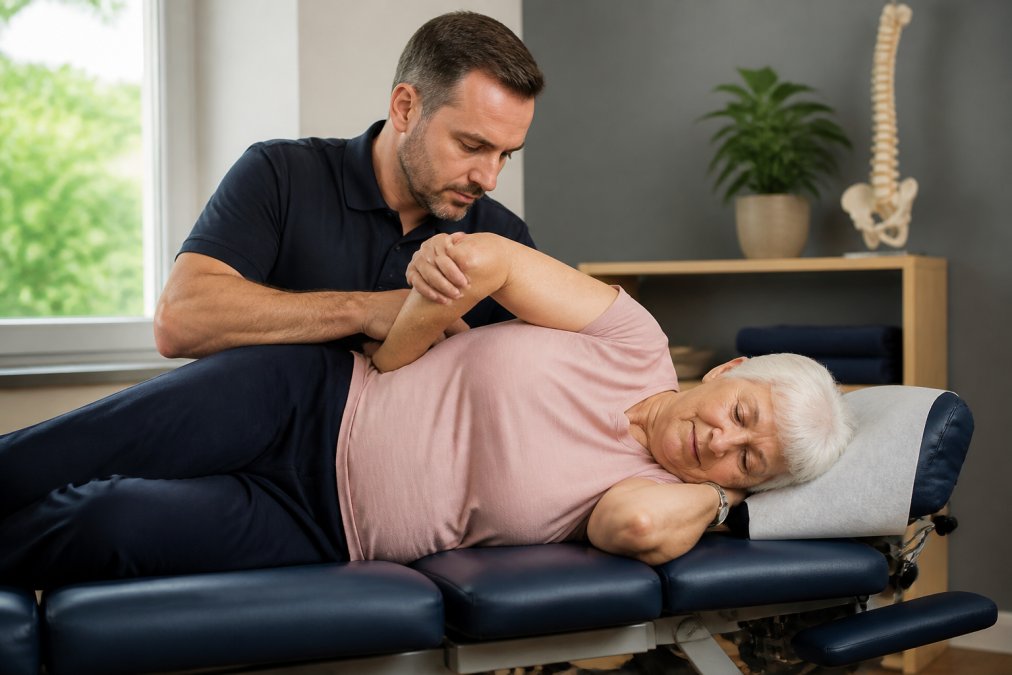
Your chiropractor will ask detailed questions about your medical history, current symptoms, what makes pain better or worse, and what you hope to achieve. They'll ask about previous injuries, surgeries, medications, and any conditions like osteoporosis or arthritis.
Next comes physical assessment. You'll be asked to move in specific ways whilst your chiropractor observes. They may palpate your spine, feeling along the vertebrae to identify areas of restriction or misalignment. They might check your posture, range of movement, and muscle strength.
Some clinics use additional assessments like X-rays or other imaging, but many don't need them for initial treatment planning. A qualified professional will explain what they're finding and what it means.
Only after this thorough assessment will treatment begin. Your first treatment is usually gentle, often just soft tissue work or gentle mobilisation. This allows your body to respond without overwhelming it. A qualified professional wants to see how you tolerate the approach before progressing.
You'll leave with clear information about what they found, what they recommend, and what you can do at home to support healing. A good first session should leave you feeling informed and reassured, not confused or pressured.
Common Concerns About Non-forceful Treatment
Many people worry that gentle treatment won't be effective. They've heard that "real" chiropractic involves cracking joints, so they wonder if a softer approach will actually help.
This concern is understandable but based on a misconception. The cracking sound, called cavitation, is just gas bubbles releasing from joint fluid (pubmed.ncbi.nlm.nih.gov). The sound doesn't indicate effectiveness. Many people get excellent results from non-forceful treatment without ever hearing that cracking noise.
Another common worry is that gentle treatment takes longer.
Frequently Asked Questions
Is non-forceful chiropractic treatment safe for older adults?
Yes. Non-forceful chiropractic treatment is specifically designed for older adults and those with fragile bones. Gentle techniques avoid the high-velocity, low-amplitude thrusts of traditional adjustments, reducing strain on joints and tissues. A registered chiropractor will assess your medical history, bone density concerns, and any previous injuries before treatment. Always disclose conditions like osteoporosis or arthritis so your chiropractor can tailor their approach safely.
What is the difference between manual and non-forceful chiropractic adjustments?
Manual adjustments typically involve controlled, high-velocity movements to mobilise joints. Non-forceful adjustments use gentle, low-velocity techniques such as soft tissue therapy, sustained pressure, and gradual mobilisation. Non-forceful methods place less stress on bones and connective tissues, making them ideal for seniors or those recovering from previous injuries. Both aim to improve movement and reduce pain, but the speed and force applied differ significantly.
How can I tell if a chiropractor is registered and qualified to treat seniors?
Check that your chiropractor is registered with the General Chiropractic Council (GCC), the statutory regulator for chiropractors in the UK. All GCC-registered chiropractors have completed accredited training and must follow professional standards and conduct codes. You can verify registration on the GCC's online register. Ask about their experience treating older adults and whether they have additional training in gentle or low-force techniques. A qualified chiropractor will be happy to explain their qualifications and approach.
How many sessions will I need before I notice improvement?
This varies depending on your condition, age, and how long you've had the issue. Some people feel relief after one or two sessions, whilst others benefit from a structured course of treatment over several weeks. Your chiropractor will assess you during your first appointment and discuss what progress to expect at each stage.
