Migraine Relief Coach
You are three minutes from the next attack, or three minutes from calmer.
Both start the same way. And the first thing I want to say is the thing most pages won't.
If you have driven home in the dark with one eye shut, this is for you.
What the coach does in the first five minutes of an attack
You open it, tell it what you are feeling, and it gives you one sequence, spoken slowly, that takes about three minutes.
- You describe it in plain words.Neck stiff. Lights too loud. Vision going soft in one eye. Not a form, not a scale from one to ten.
- It gives you one thing to do.Extended exhale. Jaw release. Eyes off the screen. Nothing exotic, and nothing that needs you to be at your best, because you won't be.
- It knows when to stop.Thunderclap onset, fever with a stiff neck, confusion, sudden weakness, sudden loss of vision. It says so in plain words and tells you where to go.
Why I am the person to build this

I ran some of the UK sumatriptan trials for Glaxo. I was not a sceptic on the sidelines. I wanted it to work. For some people it did. For me it dulled the pain and did not stop the attacks.
Then I became a chiropractor because something had shifted in my own nervous system, and I spent the next 25 years trying to understand what. I went from one attack a month to none.
I am not selling you a cure. I am selling you the method I built while trying to find out why mine stopped.
What the evidence actually supports, and what it doesn't
The vagus nerve is real, and breath, posture and touch genuinely shift autonomic state. That part is well established, and it is why slow breathing has been studied so much in pain.
What is thinner: proof that this specific five-week sequence lowers attack frequency for everyone. Migraine is heterogeneous, and the trial evidence for non-drug nervous-system work is promising rather than settled. I have watched it work for a long time in clinic. That is not the same as a randomised trial, and I will not pretend it is.
Which is why the refund is unconditional once you have finished the five weeks. I would rather you tested it than believed me.
Why it works on the alarm, not the triggers
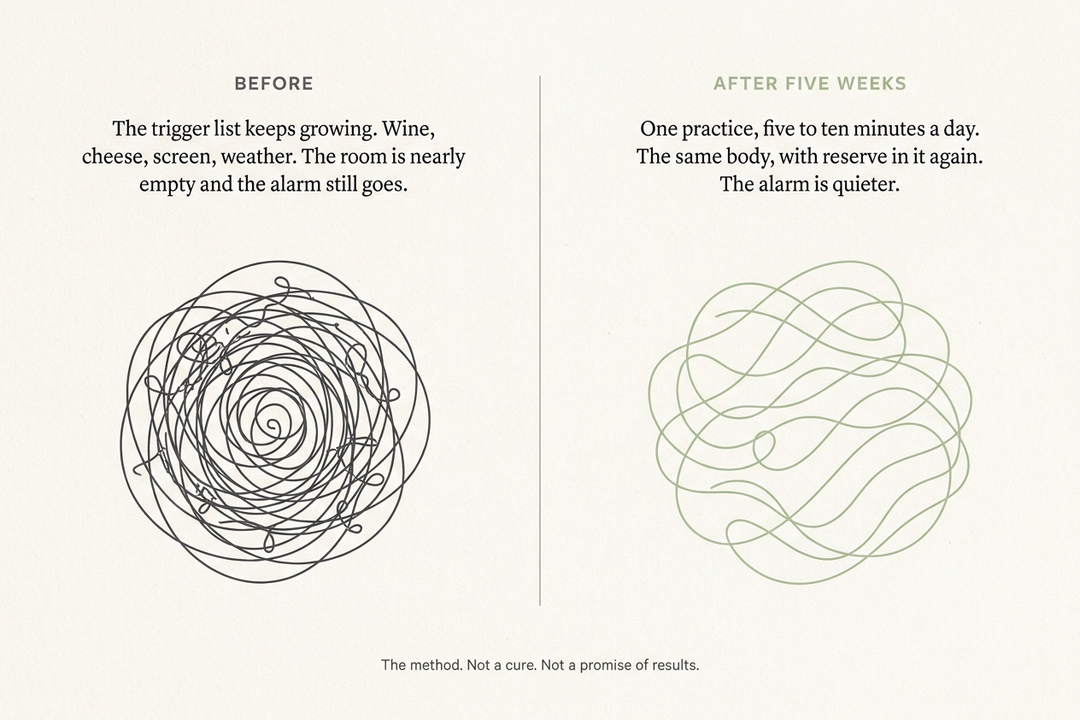
Most approaches work on the trigger. Cut the wine, the cheese, the screen, the weather. Eventually you are standing in an empty room, having removed almost everything, and the alarm is still going off.
The alarm is the problem. Your nervous system has been under load for years, and a system with no reserve left treats normal input as a threat. That is why the list keeps growing.
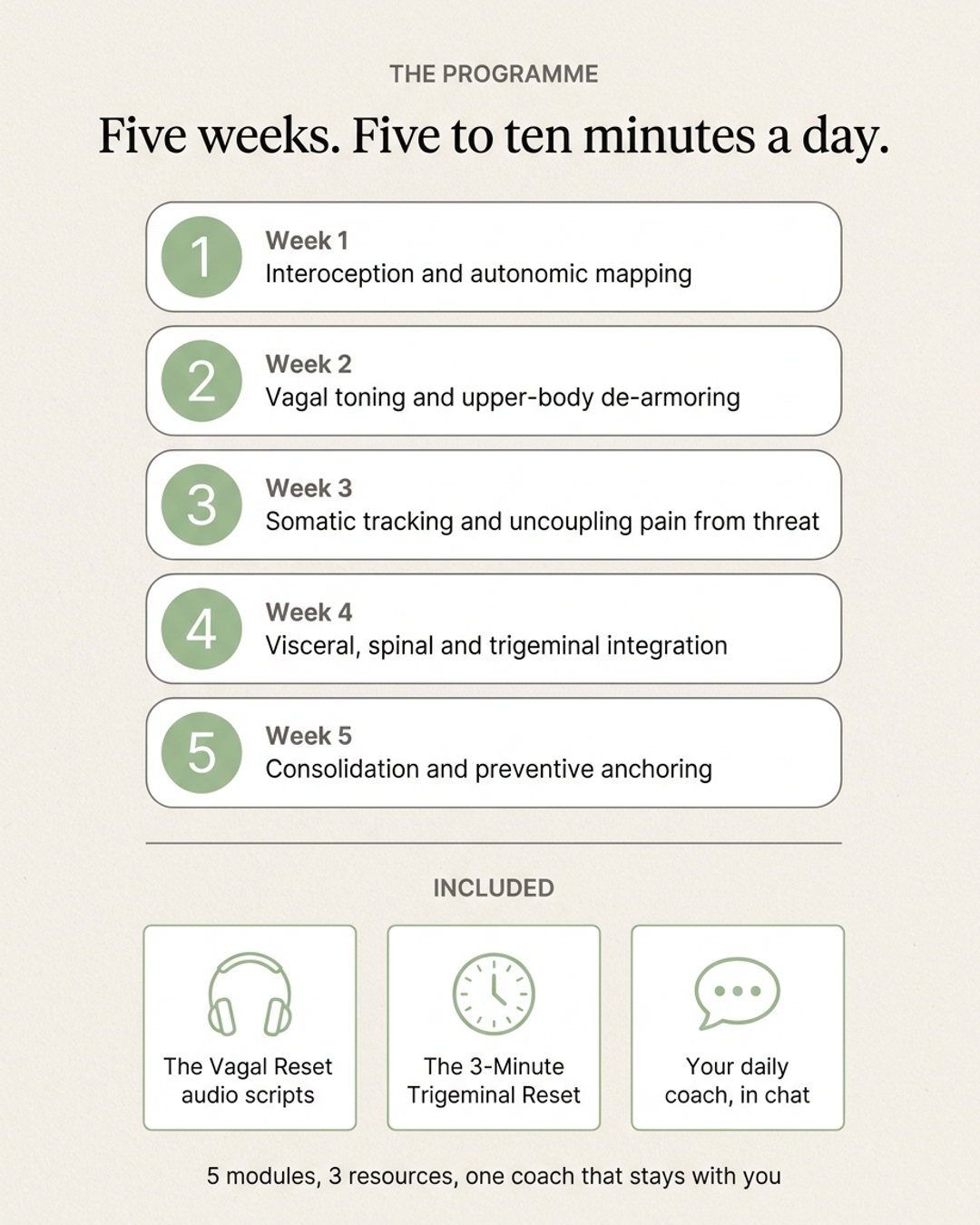
The course is five weeks of small daily practice to take the load off. Not to fix a broken system. Yours is not broken.
What the five weeks look like
Learn to catch an attack at the start instead of after it has landed. Ocular-cervical reset, extended-exhale breathing, neutral body scanning.
Stimulate the cranial nerves that dampen the pain pathway, and release the chronic bracing in jaw, neck and chest. Auricular vagus mobilisation, humming and vocal toning, jaw and suboccipital unwinding.
Observe an active headache with curious, objective attention, so the brain stops reading migraine sensations as danger. On a bad week, the acute sequence carries you until you can start.
Calm the gut-brain axis and unbind the tension running along your spine. Abdominal un-binding, spinal and pelvic rocking, trigeminal acupressure sweeps.
Embed a daily routine and build a long-term plan from what worked for you. The five-minute vagal protocol, and flare-up reframing so a future attack never resets your progress.
What's inside, before you buy
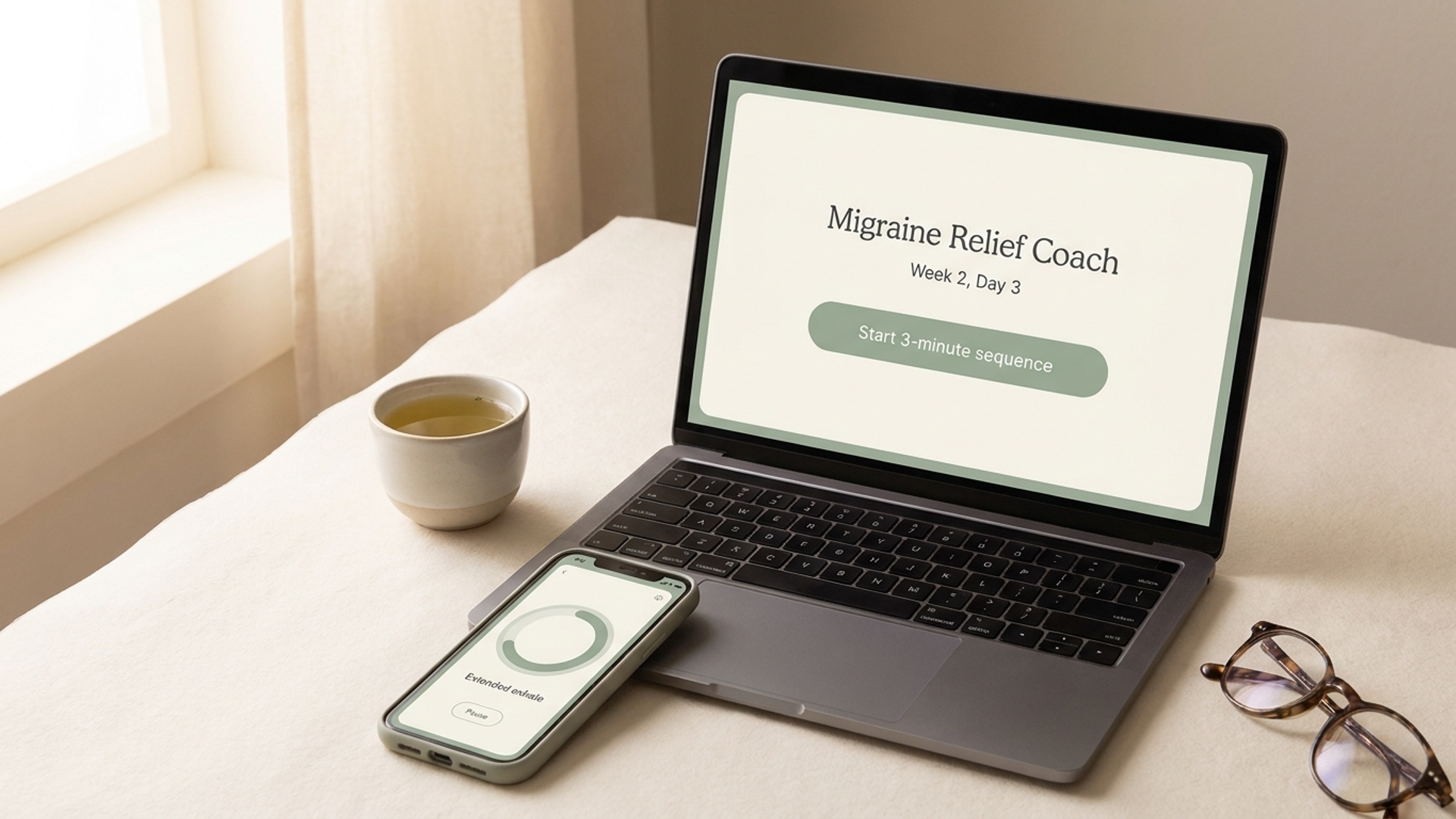
The coach lives in a browser, works on any phone, and keeps each reply short on purpose. Here is what you actually get.
Questions people ask before they start
Is this a cure?
No, and I won't pretend otherwise. It is a practice that changes how your nervous system responds when an attack starts. Some people get far fewer attacks. Some get the same number and cope much better with them.
I have tried everything. How is this different?
Most things you have tried work on a trigger, or on the pain once it has arrived. This works on the reserve your system has, which is why the trigger list keeps growing when that reserve is low.
Do I need a diagnosis first?
No. But if your attacks are new, undiagnosed, or different from your usual pattern, see your GP first. The coach knows the signs that mean get help, and it says so plainly rather than guessing.
What if I'm mid-attack and can't read?
Then don't read. The sequences are spoken, not written, and the coach keeps each reply short on purpose. Most people use it with the screen dimmed and their eyes off it.
Does it need an app or a journal?
No app, no journal. It opens in a free Eden account on web or phone, and you type the way you would text me.
What if it doesn't work for me?
Complete the five weeks and email [email protected]. You get your £47 back in full.
Five weeks, two minutes a day
£47, one time. No subscription. You keep access.
Start the five weeksPeter Bennett BSc DC, chiropractor, 25 years in clinic. Formerly ran UK sumatriptan trials for Glaxo.